Wednesday, November 17, 2010

Local Vegetable of the Couple of Days: A Concept

On Tuesday, November 16th, I had the chance to attend my first City Club of Cleveland event to hear Michael Shuman give a presentation of the Northeast Ohio Local Food Assessment and Plan. After having been to a fair amount of these kinds of events, they tend to blur a bit. The message is similar, "we can feed ourselves with local food and earn a buck while doing it." And the concrete examples of what else we can be doing right now are always fuzzy.

I'm not sure how much money this Assessment cost Northeast Ohio, but I personally believe that if all these Foundations and Governments actually spent money on building infrastructure for urban farmers (like a city tractor) or seed money (not long term subsidies) for urban farmers, instead of these wine and cheese Assessments, then we'd already have a lot more local food (and subsequent money in our Northeast Ohio economy). The exact same can be said for the much talked about wind mills in Lake Erie. I would much prefer to put a couple of windmills of various styles and platforms in the Lake, and then figure out what went right and wrong, versus all of these years of studies, cash drains, and missed learning curves. But alas! I am not a politician. I am a farmer.

That being said, there were a couple of take home points from Mr. Shuman. The first being that on average 73 cents of every dollar spent in the USA on food is for shipping. That's totally crazy! We all need to help end these unnaturally created oil subsidies and start buying local food. The second major take home point was that of creating a regional stock-like exchange for local food companies and farmers. For example, if 50,000 Ohioans bought one $100 share, that would be $5,000,000 to get some businesses incubated and off the ground. It's just then, who plays Dictator and decides which businesses get seed money? In my opinion, the grant process is heavily slanted towards white liberal arts majors, and therefore by design excludes many inner city, lower-income folks.

Given all of that prefacing, I am definitely a hypocrite, if at this time I don't provide some kind of a relatively concrete example of what else can be done right now. I came up with this idea on my drive from home to farm in Subee-1 with the Melvins blaring a couple weeks ago. I tend to do my best thinking that way.

What I am suggesting is a simple expansion of the vegetable of the day concept that somewhat already exists within American restaurant culture. My lofty expansion of the concept is the "Local Vegetable of the Couple of Days." Now let me explain how this concept would/could work.

The two main parties involved would be independent restaurants and urban farmers. And the restaurant-going public would hopefully be willing/gracious participants in this grand plan. Basically, the plan works like this. Urban farmers sell produce to restaurants on some kind of regular/irregular basis. Then the restaurants make a special dish as the "local vegetable of the couple of days" until that vegetable gets eighty-sixed. I know this sounds like what some farmers and restaurants are doing already. So I will further explain how the "local vegetable of the couple of days" concept is different from a farmer just selling to a restaurant.

First, I'll present the farmer point of view, followed by my perceived restaurant point of view.

Most of us understand that the urban farmer is dealing with an unique set of circumstances, the most limiting being the size of our plots; and in Cleveland, we have real seasonality that will sometimes make your lettuce go to seed in May. If you add to these facts that we're all relatively new to this, blight/pests, and a random x factor, then it's easy to understand how us, urban farmers, may have a hard time fulfilling a standing restaurant order, like delivering five pounds of Bibb lettuce per week to whatever restaurant from March through November. An urban farmer specializing in Bibb lettuce could pull this task off, but most of us like to be general garden plant growers and not mono-crop specialists like the Ag Industry that we're trying not to emulate.

Now furthering the urban farmer point of view, a lot of us are freaks and general plant enthusiasts that like to grow non-traditional wild-style crops even beyond the general garden varieties. I'm talking veggies like, scorzonera, jerusalem artichokes, baby bok choys, mizuna, mexican sour gherkins, etc. These kinds of veggies are hard sales in food desserts, where we're trying to get the residents to even engage in American staples like tomatoes and carrots.

So presently these amazing wild-style crops basically don't have a readily available people-based market place in the Midwest. Don't get me wrong, there are people, like John McGovern who buys two pounds of baby bok choy to make his own kim chee (pictured), but Mr. McGovern is more the exception to the rule. Even something fairly standard like arugula can be a hard sale to the public. This is where the restaurant becomes of particular value and use to the urban farmer.

At this point, the stage has been set from the urban farmer's point of view. I will now switch gears to my perceived restaurant point of view. In Cleveland, it appears that there are at least 50 restaurants willing/wanting to purchase local produce. In general, many of these restaurants could be classified as foo-foo. They have their game established. They know how many salads are ordered on a weekend evening and so forth. Regularity of work flow right down to the weekly vegetable ordering is how these restaurants function.

This is where the local vegetable of the couple of days concept provides a perfect segue between the irregular, wild-style urban farmer and the regular, foo-foo restaurant. It creates a somewhat regular forum for the restaurant/chef to showcase local varieties of produce as well as their own talents with a changing cast of a main local ingredient. It would be like they're iron cheffing it every couple of days, when the random farmer comes with a random 10 pounds of quality produce for sale. Then the Master Chef has to do something special with it, as the "Local Vegetable of the Couple of Days."

At the restaurant level this could be featured as a write-in portion on the menu, a permanent portion of the menu that says something like, "just ask about the Local Vegetable of the Couple of Days," a chalkboard/dry-erase board, or on the uber hip Ipad menu. If and when there are times without a local vegetable, simply remove it from the menu, and then call us, Cleveland farmers, out in some kind of public forum, and I'm pretty sure we'll be able to get you something good by night fall. As word of mouth goes, if you're a restaurant participating in the local vegetable of the couple of days concept, I'm also pretty sure us, farmers, will be able to find you and keep you fairly stocked.

I want to re-emphasize that the local vegetable of the couple of days concept is not to replace how current restaurants are currently buying from local producers, much like Julie of Root Cafe and Mike of Bar Cento. The concept is to supplement this already regular buying by the local food restaurant pioneers and to fully embrace it as a concept such that it creates a whole 'nother level of Cleveland food identity, where the buying public comes to recognize it and wonders if at their next restaurant visit there will be a local vegetable of the couple of days and how disappointing if that restaurant does not.

My personal favorite about all of this is that it takes no money or additional infrastructure changes. The farmers are there. The restaurants are there. There are already restaurants buying from us farmers. It's literally just a few more words to what a lot of restaurants are already doing. This concept is to further our food cultural identity by formally creating and featuring the "local vegetable of the couple of days." That's it.

Now a funny couple of things have happened to me since first starting to pen this essay. The grand result has been a lightning bolt to the head of re-realization of how important getting the local food scene out to the general public is.

One of those things actually occurred at the Shuman presentation when Dr. Ryan Terry pledged right then and there $25K out of his own pocket to get the regional food stock exchange started. At that moment, I realized that there are always various ways of communicating. Different crowds need different inputs. And if the City Club forum has the ability to have pulled off the beginnings of a local regional food based stock exchange, then that's pretty cool.

The second happened on the public forum of Facebook, at like-site for Project Orange Thumb, which is a grant opportunity from Fiskar's, the international hand tool company with the orange handles. When I asked about why the grant was not available for the for-profit urban farmer (based on the fact that I met every "community" criteria other than trying to be for-profit)? The Fiskar's rep responded on FB "I wasn't aware that there were for-profit urban farmers." SHEEESH! This is a huge international company that sells in Home Depot that isn't even aware that there is a for-profit urban farm movement. The need for education feels as great as ever. Good job Mr. Shuman and the Northeast Ohio Food Assessment. We're obviously all still getting there.

To check out the Fiskar's dialogue on FB and to see what I've done for the community in the last nine months (really is a good summary), go to:

http://www.facebook.com/#!/ProjectOrangeThumb

Sunday, October 24, 2010

What a Slacker Blogger's Been Doing Lately

About a week ago, my old friend, Sean Carnage of seancarnage.com, called me out in the public forum of Facebook about my slow-down in blogs. I assure all of you the slow-down has not been for naught. All that infrastructure that I've been writing about for months all came to a glorious head in the months of September and October. When I say infrastructure, I will clarify. I now have my fence. I now have my storage container. And on a personal note, I have a brand new driveway and garage!

So I've been doing my part for the economy. Some of you may read that last paragraph and say, "that's wonderful." And it is wonderful, but for those three separate jobs of fence, storage container, and new garage, I had to deal with no less than eight separate contractors plus the Teamsters. The thing I've learned about contractors over the last two months is that they're only on time when it comes to asking for a check. What this amounted to was being held hostage, as contractors don't seem to have a day-to-day comprehensive plan. Instead, they ask some critical question that should have been determined several weeks prior every two to eight hours for every day on the job.

Take for instance that first ever video on The Garden Life and Times of Justin Husher, which was shot, directed, and executively produced by Birch, with some Apple product. Now this video shows me in desperate times, a man beaten by nature. I was tasked with the removal of 12 wooden fence posts on a rainy Thursday so that the fence guys could put their subsequent other fence posts in on Friday. Now being that these contractors bid these jobs from paper proposals without ever having been to the job site, how were they to know these old posts were in their way? And subsequently, personally, how was I suppose to know that these fence posts were in their way, or that I (and not them) was responsible for removing these posts, being that these contractors never came out to the farm?

So when the fence guys finally did get out there and were finally putting their posts in, the process came to a halt on the south side of the farm when the fence guys informed me that the wooden posts were in their way AND that it was not their job to remove them. I scrambled calling everybody I knew for help. Like the ol' reliable that he is, Birch came to the rescue. First, we tried digging the posts out, then digging plus sledge-hammering, then digging plus sledge-hammering plus drilling posts into the fence posts to give us a better grip. Through these processes, we were able to extract five posts in two hours and were feeling broken.

Of course, that's when Subee-1 came to the rescue. Basically, Subee-1 became a battering ram extraordinaire. What we hoped to accomplish with 50 sledge-hammerings was completed with one or two rams from Subee-1. Subee-1 so thoroughly loosened the fence posts, we no longer had to do any digging, and the posts literally just pulled on up. The last seven posts came out in an hour. I encourage everybody to check out the minute long video, and if you're a National Marketing Manager for Subaru of USA, then it's a must.

As of now, the fence is completed. It looks great. Sterling Fence did a great job and were a pleasure to work with despite the last minute scrambling. The Federal bidding process for my Stimulus dollars saved me and my grant a lot of money, which ultimately allowed me to afford my shed, which is actually a re-purposed storage container.

For the record, I want to thank Randie Kuhn of OSU Extension. Because without her, the Re-Imagining Cleveland Grant would be and would have been nothing.

Now back to the shed, I opted for the re-purposed storage container instead of your run-of-the-mill shed because I didn't want it to get stolen. This is Cleveland, and entire 10 by 10 sheds have disappeared overnight. Given all of the horror stories about the neighborhood from the mouth of Pete Gagepro across the street, I wanted something secure, and a flimsy ol' vinyl shed from Home Depot wasn't gonna cut it.

At this point, I obviously now have my shed, but it too had its share of prep work. There were two days of weedy tree removal, performed with a calorie-burning handsaw and not a gas-burning chainsaw. However in hindsight and for future applications, a chainsaw would be welcomed. There was the two days of site prep, which included the tilling and leveling the area one day, and spreading and leveling four tons of lime stone the next.

However I would have given thrice the site prep for the paint prep, which there were five days of and really sucked. These five days could be roughly broke down into two days of scraping/removing Hyundai decals, a day of sanding/rust removal, a day of using gnarly solvents to get rid of the leftover sticky of the decals, and a day of Rustoleum priming coupled with a Dr. Bronner's light hempen soap bath.

The painting was fairly easy with each coat taking about a half day per application. I got a lot help with the actual painting. Lisa Carlini of Origins Beanery is featured in the action photo above. My long term vision for the shed includes painting the mural of my logo on the front and a DIY green roof on top.

Whilst all this was happening, the farm stuff on the farm didn't magically take a leave of absence, and Gordon Square Farmer's Market just ended for the season on October 30th. For the last market, I had paddy pans, mizuna, baby bok choys, radishes, basil, and sundrieds. Though in the middle of October, I still had eggplants, tomatoes, and peppers. I feel fairly accomplished in my late season offerings as I didn't use any kind of season extenders.

And whilst all the all of this was happening, I still had to break down and plant in for the season. My 17 pounds of garlic was literally just planted and mulched on Halloween weekend. The sunchokes got in the week before that.

I'm almost at a critical rest for the year. Basically, all I need to do is one last seasonal mow, which should happen later on today. When I write "critical rest," I refer to things that I have to do and not those I still want to and can do this year. I've liberated 36 yard bags of leaves so far for my farm composting. I would like to make it an even 100. Again, it's not critical, but I'd like to do it.

Going in to the winter future, I promise I will try to write more. I have a million topics to write about: trains of thought, my first season reflections, cultural critiques, advertisements, reporting on wine and cheese events, etcetera. Speaking of wine and cheese, it feels like there's a local food event everyday here in Cleveland. I went to two events last week and will be checking out another two this week. The beauty is the fervor-ed pitch is coming from all corners of the city, de-localized and de-centralized.

Needing a winter time activity other than surfing Australia, I'm also in deep contract negotiations with Gardens Under Glass to come aboard and learn hydroponic gardening in the Galleria of downtown Cleveland this winter. Last of all, Green Urban Enterprises may be going to court and suing over a purchase of a faulty piece of machinery bought earlier in the season. We'll have to see on that one, but I was hoping to avoid litigation as long as possible as part of my business practices. It's a shame that there are con-artists in the world.

That's what a slacker blogger's been doing lately.

Wednesday, October 13, 2010

Local Foods Week Cleveland

From October 2nd to the 10th, we celebrated the first hopefully annual Local Foods Week in Cleveland, where Cleveland Foodies were instigated into taking on the "Eat Local Challenge" that comprised of three harrowing tasks. Task 1 was to eat a local meal a day and post photos (of which I'm trying to comply now). Task 2 was to attend a local food event. And Task 3 was to support local farmers, farm markets, and restaurants.

Obviously, I personally accepted the challenge and won! However, it was not the elegant, graceful win that I had hoped for. Prior to Local Foods Week, I had imagined lush daily meals made with subsequent daily trips for farmer market goods. This week-long culinary epic horizon was crushed with the eight-pound shoulder that I slow barbequed, mopped, and pulled (pic 1) over apple and oak logs for six and a half hours on October 1st in celebration of rock band, La Otracina, making their way through Cleveland for the first time in two years. The shoulder was from a non-certified organic Creston, Ohio hog that I bought half of several weeks ago. Those french fries in the picture are Yukon golds from the Farm.

Though La Otracina are skinny Brooklynites, they ate wholeheartedly that evening, as did other musical luminaries like Lightning Fingers and Josh Snuff. October 2nd was the "official" start of Local Foods Week, and we (me, Sarah, and Otracina) partook in the Challenge with non-vinegared and instead chili powdered pulled pork breakfast burritos (pic 2) with purple onions from Old Husher's Farm, Morgan Farm Stay eggs, organic herbed cheese bought from a Amish Go-Between at a LEAF event this summer, and leftover bacon-mashed pinto beans from Rose Angel on W 58th. The condiments were Texas Pete Hot Sauce from North Carolina, Chipolte Tabasco from Avery Island, Louisiana, and Cholula from our brothers and sisters in Mexico. Day One, check.

Day Two was my favorite individual day of Local Foods Week. This is because I cooked the least and ate the best that day. Eating the best came as a courtesy from Lakewood's most aggro farmers, Bay Branch Farm. Yep, Annabel and Eric opened up their home and hearth for us heathens. The table-spread picture above (pic 3) is from the Bay Branch Party. My personal fave was the Yukon Gold potato salad with arugula accents (both grown at Bay Branch). However, Sarah begged to differ and preferred the beet salad (more Bay Branch produce) with the Lake Erie Creamery Chevre. I cooked up a pair of blue hubbard pies (pic 4) from the farm, and though there were three pumpkin pies, mine was the first to go. This probably had more to do with the fact that we brought a spatula and drew first slice, rather than some competitive tasting, as Ryan Kennedy's pumpkin pie was no less delicious. The chit-chat was great and ultimately devolved into subject matter relating to the competitive state of urban farming in Cleveland, Ohio. Day Two, check.

Day Three was a mellow day for me and Local Foods Week. Remember that eight pound shoulder and the other blue hubbard pie? Day Three, check.

Day Four was another no-cook day for me, but that evening I went to the Growhio Web Launch party. Thereby, completing Task 2. And since the Party was graciously catered with tasty treats from Flying Fig and Ohio City Burrito with a conscious effort to include locally grown food in the offerings, I was able to get my local foods meal in that day. Growhio's mission statement "is to increase demand for local food products and services by acting as an educational resource for information seekers, consumers, and future local food participants." Not only that, I'm "supposed to be" Growhio's first featured farmer with a question and answer style interview. Considering that Old Husher's Farm is not mentioned even as a link on the Growhio site yet, I'm starting to wonder if that "supposed to be" has fallen to the wayside. I should probably follow up with them on that. Regardless, Day Four and Task 2, check.

Day Five was Wednesday, hump day. It came with its own little micro-challenge, to eat at a restaurant that regularly buys from local farmers, of which there are probably about 10 to 20 of these restaurants in the area. Right here in my little village of Lakewood, Ohio is Root Cafe. Root is a coffee shop with an amazing beer and food selection. They buy from five or six separate farmers in the area, including Bay Branch. As you can guess, Day Five was another no-cook day with my local meal being provided by my pizza lunch at the Root (pic 5). Day Five, check.

Day Six, Seven, Eight, and Nine went a little something like this: pulled pork sandwich, followed by another breakfast burrito, followed by more pulled pork, then some Italian sausage from that same hog with some purchases from Gordon Square Farmer's Market on Day Eight and little snacks of blue hubbard pie peppered throughout those days. This was kind of an uneventful way of concluding the First Annual Local Foods Week Cleveland. But when you do a whole shoulder, it's best to eat it all.

Right now in Cleveland, we're celebrating our 2nd Annual Beer Week. Last year, the Week was hardly a murmur, meaning I didn't know it existed until after it was over. This year's Beer Week has a ridiculous amount of events and brewers flying in from all over the country. Sarah and I indulged in a food and beer pairing at the Beer Engine that matched 15 of Boulder's Avery beers with 15 petite courses. My favorite pairing was the sour beers with the stinky cheeses, which are two food groups that I generally dislike, but completely synergized together. The word on the street from the Cleveland Beeries is that this 2nd Beer Week has "blown up" from last year. Let's hope the same for next year's 2nd Annual Local Foods Week.

Wednesday, September 22, 2010

Paw Paw Fest 2010!

Last weekend on September 17-19, I had the pleasure of attending my second Paw Paw Fest outside of Athens, Ohio. These trips down to Athens are becoming way ritualistic: the Skyline Chili pre-visit in Canal Winchester, Ohio, the comfortable log cabin accomodations, the mandatory purchases at the Athens Farmer's Market, the dinner trip to Casa Neuva, even seeing my buddy, Scot's mom's equestrian friend, Jane for two years in a row, and rock n roll at the Union, where coincidentally Cleveland's Self Destruct Button played this year.

So our hosts, Sarah Harter and Adam Hughes, have been a couple for a longggg time. And I'm proud to say that I was able to give them their first his and hers matching t-shirts, those being "A Farm in Cleveland?!" Adam took to his right away, wearing it to Paw Paw Fest on Saturday, where the positive re-enforcements came in the way of mega-compliments, even landing one from Warren Taylor, the Dairy Evangelist of Snowville Creamery. Sarah seems to be still warming up to hers however...

Now prior to getting down to Athens last weekend, Adam had called me and gave me the foreboding news that "his" paw paw patches were barren, and basically there were no signs of paw paws either: no flowers, no raccoon scat, no seeds, no rotting remnants.

In my quest to be the Paw Paw Ambassador of Cleveland, I've taken it upon myself to literally bring paw paws to the people in the form of education and as of this year actual paw paws. But the lack of forage-able paw paws made my task a daunting and potentially costly one. Upon midday arrival at the Fest, I immediately started scoping out paw paw prices, wondering could I get a bushel, a peck, or some other obscure large quantity. And the astounding unanimous answer to that wonderment was a definitive "NO!"

Peterson's Paw Paws and Chris Chmiel's Integration Acres were the major retailers at the Fest. Peterson's is the old man on the paw paw block. I'm not sure where they're from or how long they've been doing it, but the general consensus is longer than anybody else. Peterson's acts as both a grafted paw paw tree stock nursery with several proprietary grafted strains like the Susquehanna (my fave) and as a retailer of those high end paw paws. At $10 a pound, Peterson's looked like they were going to be sold out by Sunday. Integration Acres was selling theirs at $6 for a quart box, which was a slightly more affordable option, but still a very far cry from any kind of bulk pricing.

Last year I spent a considerable amount of time at the academic lectures. Whereas this year, I went with more of leisurely approach to hanging out at the Fest. The one presentation that did catch my undivided attention was "Sustainable Staple Foods." The presenters were the Appalachian Staple Foods Collaborative and/or the Shagbark Seed and Mill Company. These folks are the same people doing several different things and most of the content last weekend was on the Shagbark Seed and Mill Company.

From what I got out of the lecture, Shagbark's main goal as a business is to provide processing infrastructure to support small-scale staple food farmers in areas like milling and threshing with ultimate ideals of creating food independence for Appalachia. One of my favorite quotes of the lecture was to the effect, "You heard of the Tea Party? Well, we're forming the opposite of that called the Eat Party with food security being our primary mission!" All this talk about food, I should probably mention the crops that Shagbark was touting. These were amaranth, heirloom corn, turtle beans, and spelt. To my surprise, there were no mention of potatoes or sunchokes.

One familiar story Shagbark told was that of "farming acres." This is an alternate reality that us, urban farmers simply don't have. I believe it adds another conundrum to at least my urban farming hypothesis. Conceptually, I want to grow staple foods and feed the world. Economically however, I have to grow what earns my best return for my amount of work. Ideally, I'd like to be a fence-walker and do a bit of both. However, this is not a blog of conceptualizations! This is a blog about about Paw Paw Fest 2010! And that brings me to the uncertainty I was feeling after the lecture, as we were going into Saturday evening without bulk paw paws on the horizon. I believe Adam sensed it.

He expressed re-assuring sentiments that he was sure there were paw paws out there, either on some nether region of his land, or elsewhere places not yet explored, and that I would go back with paw paws for the people of Cleveland.

On Sunday we opted not to go back to Paw Paw Fest, but instead to go on a Quest for El Pawpawrado, the legendary City of Lost Paw Paws to us, gringos, guarded by the voracious Pawsquatch. We loaded up the Toyota Land Cruiser with baskets, teepee, a week's worth of food, a satellite phone, and other necessary survival implements. At daybreak, we were off to find El Pawpawrado with black coffee as our fuel and visions of paw paws as our spiritual guide.

After fording the Tuscarawas, Athens, and Muskingum Rivers, we parked the Land Cruiser next to an abandoned barn and trash heap. We lost our horses in the Muskingum; so from there, we'd have to go by foot. After matchete-ing through six hours of wild roses, poison ivy, and other very burr-y wonders of nature, we found El Pawpawrado. There, we were blinded with the emerald light shining through the majestic paw paw leaves, as if we were in Tron and everything glowed highlighter green instead of highlighter blue. After a couple hours of tree climbing, tree shaking, and simple picking of the low-hanging fruit, we had filled our baskets with 23 ripe and underripe pounds of glorious, custardy, pawpawee flesh. I would not go back to Cleveland empty handed! We left all overripe and quite ripe paw paws as an offering to the woodland critters and Pawsquatch.

After dividing the bounty with my Sherpa and Junior Associate, Ryan Kennedy, I was left with 15 pounds for the retail markets of the greater Cleveland area. I sold five pounds yesterday at $8 a pound. So I'm at the break even point in terms of gas. The demand seems unreal. Here's to new rituals.

Thursday, September 9, 2010

AUGUST WAS INSANE

And September continues to be the same. The last blog I went on about maggots a bit and never really got to the insanity that was August. So today, I will continue that blog (now in the past tense). But before I do, I just want to go back to the maggots for a moment. It turns out if you look really hard or increase the size of that top image, then YOU CAN SEE THE MAGGOTS IN THE BONEMEAL! YAY!

Five trips downtown to City Hall, countless hours later, fourteen bucks for parking, $150 for permit fees and associated costs, a $35 parking ticket, and a Board of Zoning Appeals hearing, I HAVE MY FENCE PERMIT! YAY! After all that, you may think that I'd be getting a 10 foot fence with barbwire and machine gun turrets, but no actually, it's five foot black vinyl mesh. I give major thanks and appreciation to City Council President Sweeney and Melissa Miller of Bellaire-Puritas Development Corporation. Both had my back at the Zoning Appeals hearing and literally went to town for me. Without them, I'd probably be a fenceless farmer exposed to the wilds of Cleveland. I give my apologies to Pete of GagePro across the street, who acted as a friend and then blindsided me with an objection letter to the Board against my fence, against my business, and against my person.

So Pete, I'm sorry. I got my fence. Considering you have literally zero green space on your completely blacktopped property and considering that preservation of green space was one of your five objection reasons, then I suggest to you that you green up your own land and property, and leave me personally be.

If there ever was a time to soapbox, for me personally, now is it. Everybody and anybody, who cares at all about urban farming in general and specifically urban farming in Cleveland, needs to call their Council Person and let them know you support the Urban Agriculture Overlay (UAO). In a nutshell, the UAO will create usage zoning that will allow us, Cleveland Urban Farmers, such farming amenities as hoophouses and fences without all of the fuss I just described. An urban farmer could farm with relative startup ease if the UAO passes. The UAO will also help to set National precedent for other cities to create similar urban farming zoning. It's easy getting a hold of City Council. Just copy and paste from below.

http://www.clevelandcitycouncil.org/Home/CouncilMembers/tabid/59/Default.aspx

Now to get off my soapbox, I'll tell you some more about August 2010. Besides melons, maggots, maneuvering, and grant writing, there was and still are tomatoes, lots and lots of them. I've taken the non-business zen approach to tomato quantity calculation, and all I can say again is there are lots and lots of them. I just filled my 100th half ounce bag of dehydrator dried sundrieds. I do know it takes a half pound of tomatoes to create a half ounce of sundrieds. So that's 50 pounds of just sundrying types of tomatoes right there. Then there's the quarts of sauce, and all the sales. I wake up in the middle of night, thinking of ways to keep the tomatoes flowing. In general, I use FIFO, an accounting acronym that means first-in, first-out. At the Market, I sell 'em individually, any tomato for a quarter, or in a brown bag bundle for $2.50 to $3.50. Some of the ultra-cool/high demand tomatoes like the Green Zebra only get brown bag bundled. Selling tomatoes in August was a difficult business challenge that I feel I ultimately won. Experimenting with pricing models was crucial and having someone like Sarah Perkins, who is literally the Cookie Monster of Tomatoes, on my side also helped tremendously.

With all those melons and tomatoes, it's no wonder my house became a fruit fly resort for a little while. Additional sweet sweet news is that Cleveland formally awarded me the Gardening for Greenbacks Grant for $3K. Thank you, Cleveland. I also gave my first urban farmer interview with Elizabeth Emery of Growhio. I will be Growhio's first featured farmer on their almost revamped website. I had my first shared farmer market stand with Central Roots selling luscious greens. In hindsight, August seems like it was an incredibly productive month. September is shaping up to be the same with the shed installation and site prep, including moving and spreading four tons of limestone later on today for the base of my shed. Then, there'll be the shed painting project...

For me, one thing at a time wins the race.

Saturday, August 21, 2010

AUGUST IS INSANE

Like the title says above, August has been and is insane. Starting with some gross news. Who knew that when bone meal gets wet, it becomes rancid? All things considered bone meal being what bone meal is, I should have known. So the other day, I was about to top dress some cukes and paddy pans with said bone meal and was totally aghast-ed by the stench. I was like, "whatever," as I really wanted to fert my crops. And then when I dug my hand shovel into the meal, I had a total "Lost Boys" moment where the whole five-gallon bucket came alive with maggots. Only, I wasn't vampirically hallucinating, the entire bucket was bone meal, maggots, and wretched. I tried to take a picture, but the little buggers just blend so well with the meal, the jpeg wasn't worth publishing. I ended up dumping the bucket and its contents right into the middle of my compost, thereby making a high phos compost blend that will probably need major leaf dilution before it's safe to use. Who knew?

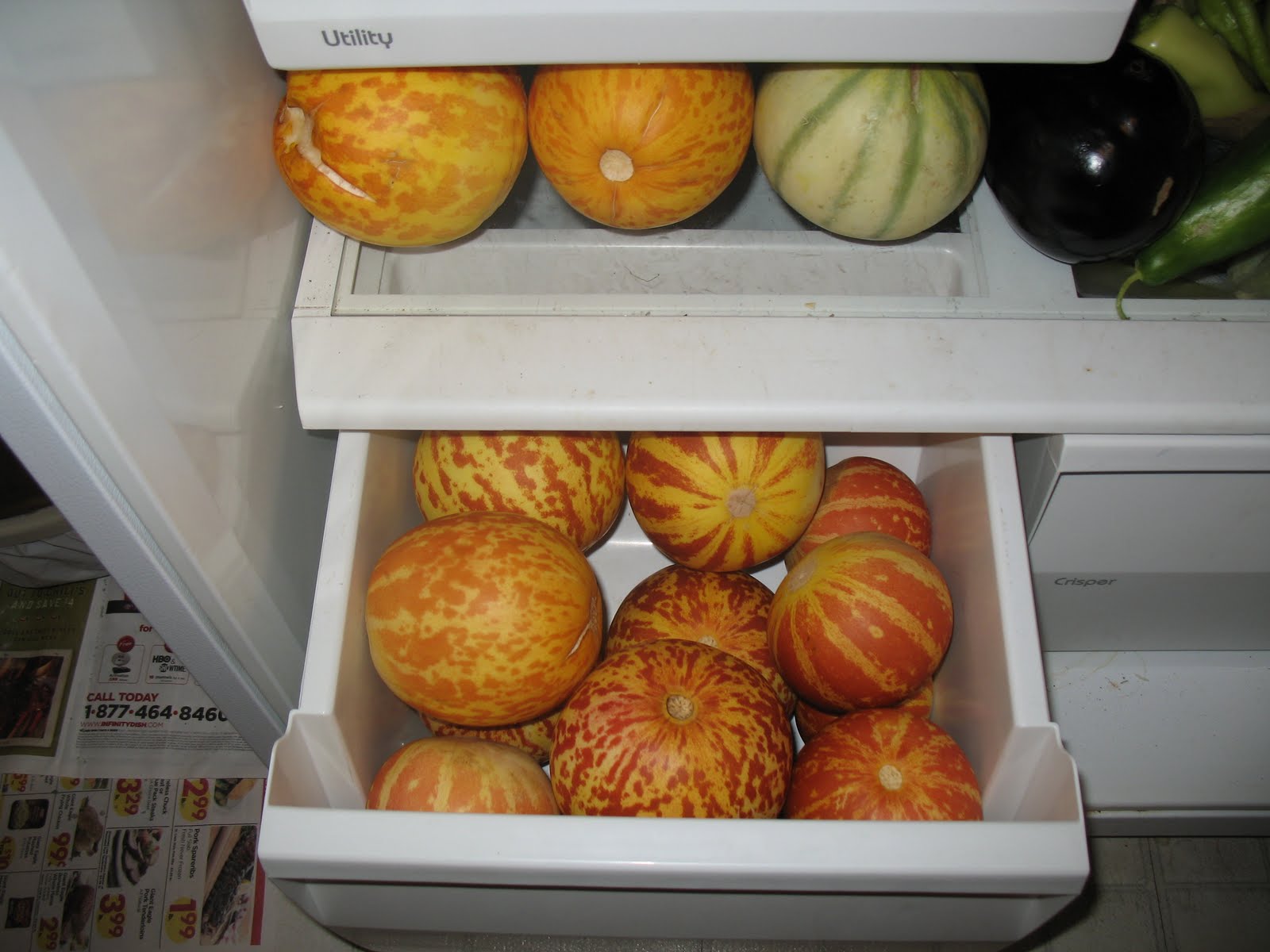
About two weeks back, the melon patch came in fast and hard just like my metal. Smellin' Melon Mania I was born! In one corner of the ring was the classic, four to seven pound, ultra foo-foo, French Charentais, tasting like the best cantaloupe ever plus rose water with pink-orange juicy-juice flesh. In the other corner was the somewhat scrappy, one to three pound, tag team of the Far North classic American cantaloupe, and its Armenian flashy cousin, the Tigger, looking like a Super Mario Brother's fireball and handsomely displayed in the photo above. The Tigger's aroma was somewhat intoxicating, and I was starting to feel like a bumble bee in my own home with every room smellin' of melons.

Now, this Melon Mania may have sounded like a little slice of heaven, and for the most part it was like a little slice of heaven. But when 20 ripe melons are picked in one day, the refrigeration bottleneck of my business is immediately realized. Subsequently, I learned a new kind of hustle because of my refrigeration problem. I had some knowing and unknowing participants in my quest to de-melon. On the knowing side of things, I give thanks to Rob Burgoyne and Lakewood's LEAF organization, who let me guest-vend on a 12-hour Facebook-notice in front of the Lakewood Library as part of LEAF's CSA program on Wednesday the 18th. And a week prior on the unknowing side of things, I give thanks to Lakewood's Bela Dubby coffee shop, which subsequently allowed me to visually and aromatically entice their customers with my melons, when incidentally I was bringing a Charentais to a friend during Bela's movie night, and when incidentally I had three others just sitting there on my car seat. All in all, I sold four Charentais out of the Subaru that evening.

For the sake of blog publishing, "August Is Insane" will need to continue in the near future.

Tuesday, August 3, 2010

Alright, I'll write already.

Borrowing and rephrasing a line from some old Lungfish, alright, I'll write already. I've been busy with non-exciting stuff, like up top there is a picture of my application for Gardening for Greenbacks plus the proprietary edits that my attorney recommended. I finally got that turned into Ifeoma at the City of Cleveland's Economic Development Department. That was like a half year's brainstorming funneled into a necessary yet punishing week of extremely formalized/organized thought and then action. I'm glad it's over with. I just need to hear the yay or nay, and move on from there.

Never thought I'd say this, but I'm starting to feel like Dwight Shrute from the Office. My first major harvest, which is totally separate from rinky-dink single pickings, is beets galore. There's Goldens, Early Wonders, Chioggias, and Crapaudines, which were no good despite the name and being the oldest root beet known in existence. The Chioggias are the Santa Claus-red ones in the picture and are also known as "candy stripe" beets to us common folk. Weird thing was, about every fortieth or fiftieth was completely white, like a slightly muddy ghost beet. And for the most part, these ghost beets tasted like earthened sugar with a mealy texture that would pair well with oatmeal.

Also, pictured up top is Green Urban Enterprises' non-patented Root Crop Rinser, which doubles as the equally non-patented Compost and Soil Sifter, made with every day farm items like 1/4 inch chicken wire, roofin nails, and re-purposed 2 by 4's from Birch's garage. That thing is going to be a lifesaver.

I swapped some fish for mineral fertilizer the other day with Eric Stoffer of Bay Branch Farm, and we got to chatting 'bout our respective farmer's markets, he at Lakewood Farmer's Market, me at Gordon Square's. We got to talking about this and that, and we got onto the dirty subject of reselling.

Reselling. It just makes my skin crawl. Reselling is the act of buying produce from a wholesaler, and then passing it off, and "reselling" it as your own. Reselling is totally different than helping a brother/sister farmer/gardener sell some produce in conjunction with your stand. This latter action is most often fully disclosed to give props to both farmers, is local, and results in real local monetary gain for both participants. Resellers, in contrast, buy bulk produce from California, China, and where ever else, and then sell it to the customer as "their own" or "local." I feel that us, Urban Farmers, need to rally against this practice.

I had some killer marketing ideas present themselves to me today over breakfast in regards to next year's plant start sales. I can't tell you the details because that would break my confidentiality agreement. I'm just saying it's kind of strange when and where inspiration hits. Be ready for it.

Well, it's a day later and I'm just looking to get this blog entry done. Today, I harvested this year's first Far North cantaloupes, five of them. I hope to get them to market on Saturday, but seeing's how cantaloupe is literally my favorite flavor in the world, it's looking doubtful for my customers, especially when my whole kitchen smells of melon for 10 minutes after opening up the fridge. Also, picked my first couple of ears of sweet corn ever today. So, I have the jitters in anticipation of my virginal kernel crunch popping sweetness. In conclusion, I've been thinking about commissioning a cement garden gnome in my likeness.